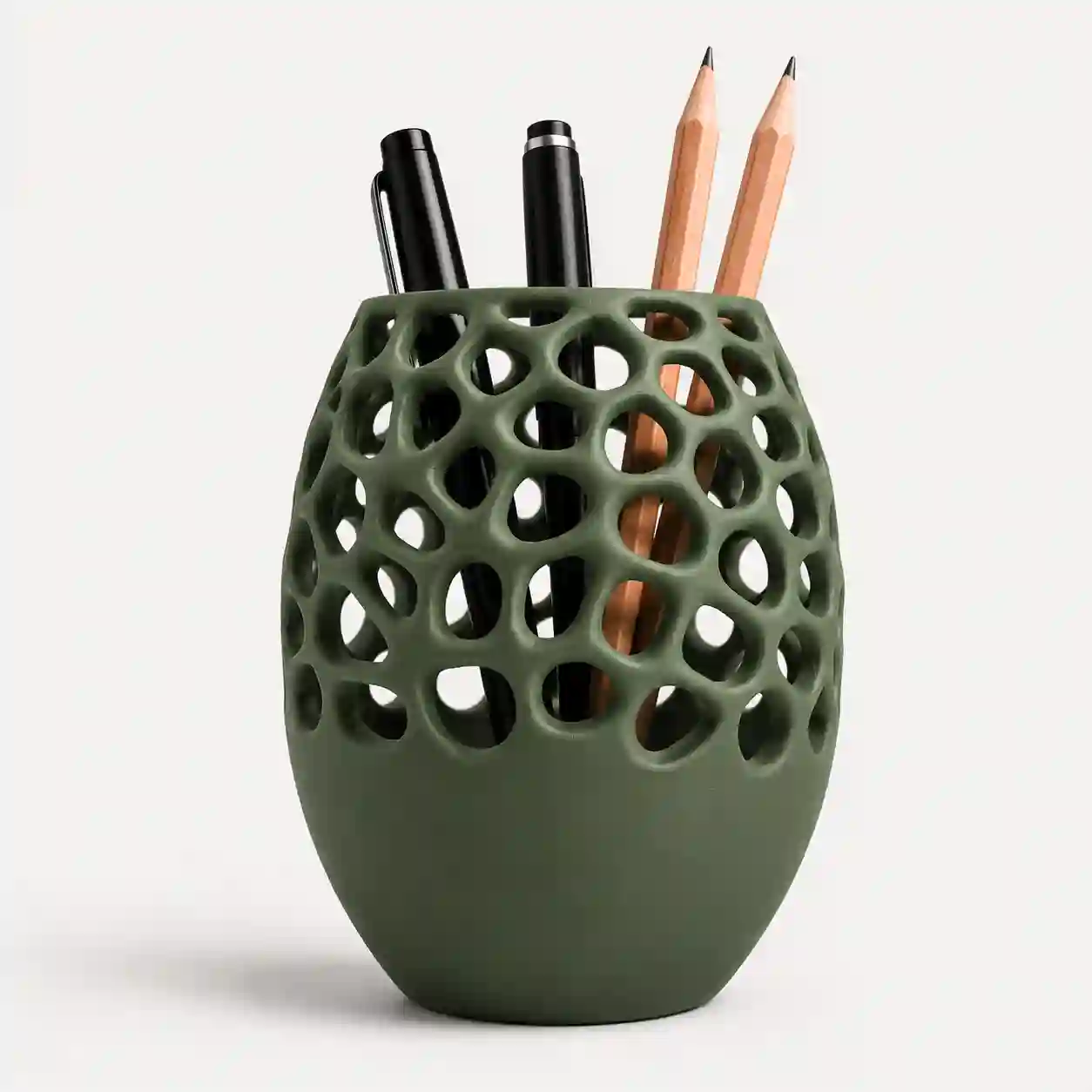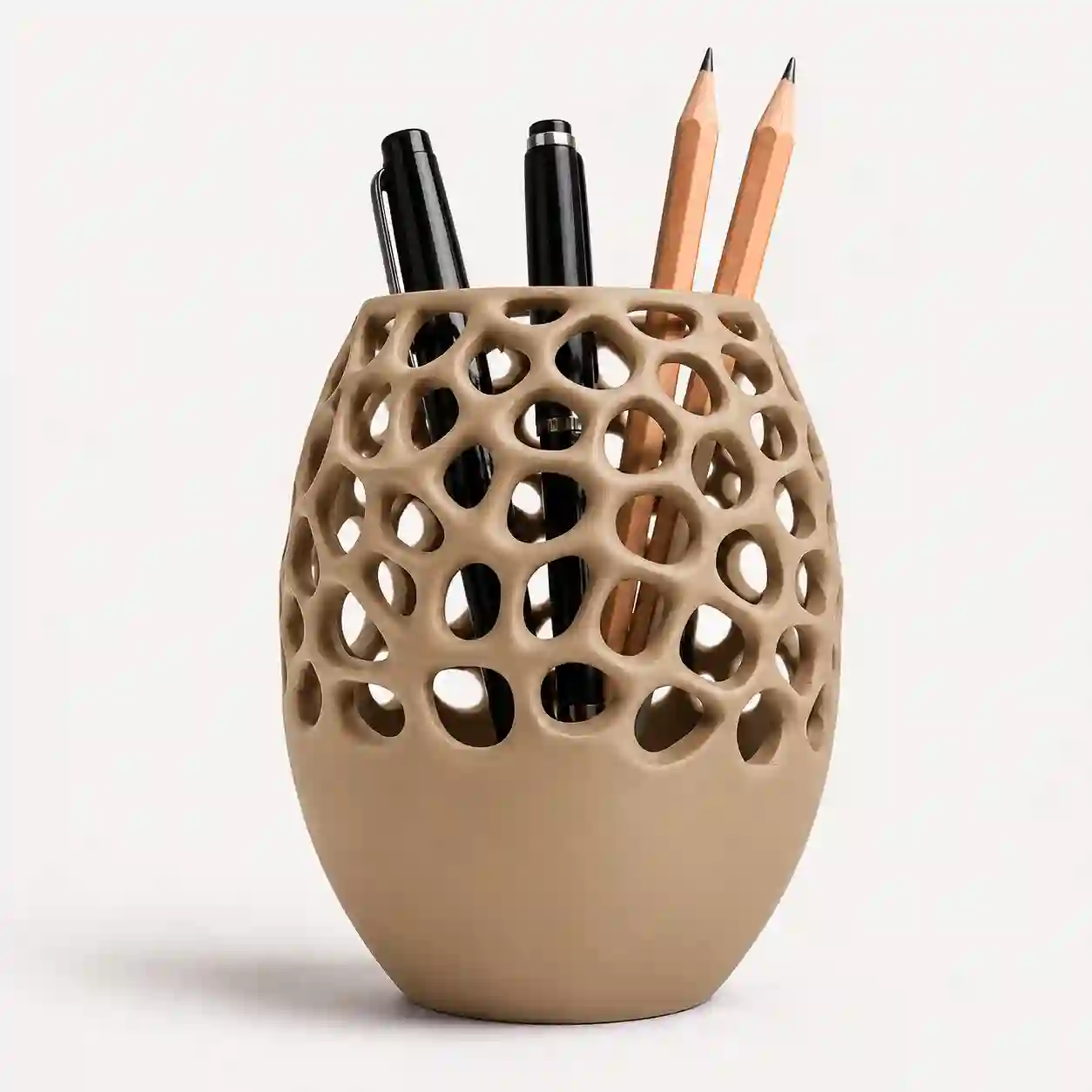
Voronoi patterns appear in leaves, giraffe skin and soap bubbles. Here is how that pattern became our 3D printed pen holder.
In this story · この物語の品
The cells of a leaf, the patches on a giraffe and the walls between soap bubbles all share one pattern: the Voronoi diagram.
What is a Voronoi pattern?
Take a set of points and divide the space so every area belongs to its nearest point. The result is a web of organic cells, which looks natural because nature uses the same rule.
Why 3D printing suits it
The open lattice would be hard to make any other way. 3D printing builds it layer by layer, so the holder is light, strong and eye-catching.
Colours
Beige, Olive Green and Lavender.
Setup ideas
- Minimal desk: Beige blends with wood and white setups.
- Plant lovers: Olive Green sits well next to desk plants.
- Pastel setup: Lavender suits a soft, aesthetic workspace.
- Beyond pens: makeup brushes, paintbrushes or a stylus.
Did you know?
- The pattern is named after the mathematician Georgy Voronoi, who studied it in 1908.
- Voronoi patterns are used in architecture, city planning and even to model how cells grow.
- The open lattice uses less material than a solid holder while staying strong.
Frequently asked questions
Will small items fall through the lattice?
Pens, pencils, markers and brushes sit securely; very small items like paper clips are better in a closed container.
What is it made of?
PLA, a plant-based plastic that is common in 3D printing. It is light, strong and has a fine layered texture.
Is it made in India?
Yes, it is designed and 3D printed in India.
How do I clean it?
Wipe it with a soft dry cloth or brush. Keep it away from strong heat, like a car dashboard in summer, so it keeps its shape.
How is it delivered?
Packed securely and delivered across India. Report any transit damage within 3 days with an unboxing video and we replace it free.